AI Tutor vs AI Chatbot
An AI chatbot can be a great study tool. It can explain a confusing paragraph, generate examples, rewrite a definition, quiz you on a topic, or sit patiently through the same question three different ways.
That usefulness is real. It is also easy to mistake for tutoring.
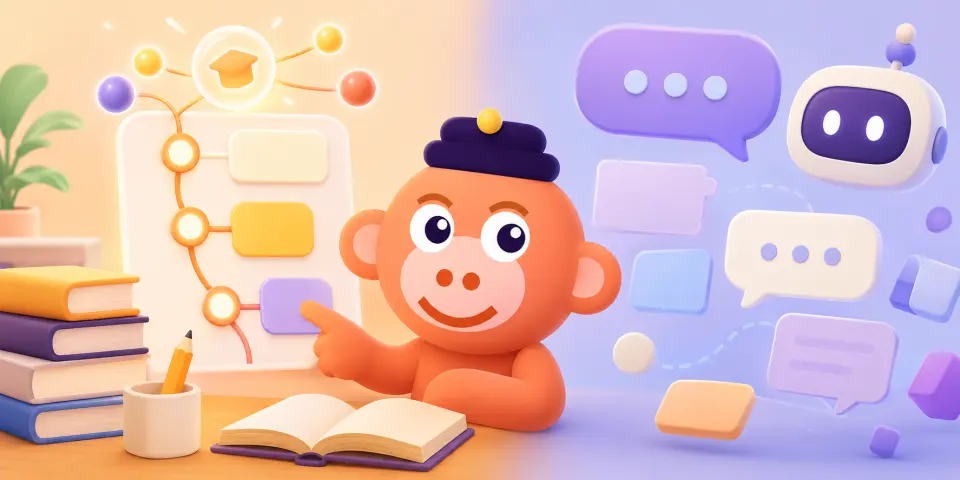
The difference between an AI tutor and an AI chatbot is not personality. It is not whether the interface feels friendly. The difference is whether the tool is built around a learning loop. A chatbot responds to prompts. A tutor guides a learner through a subject, watches what happens, and changes the next step.
A chatbot is a reference desk
The best way to think about a chatbot is as a reference desk that never closes. Bring it a question and it can usually help.
"Explain Newton's second law in simple terms." "Give me a Python example using dictionaries." "What does this sentence mean?" "Create five practice questions about photosynthesis."
For those moments, a chatbot is excellent. It lowers the cost of asking. It gives a learner a place to be confused without embarrassment. It can rephrase, simplify, expand, and offer examples on demand.
That is why chatbots are valuable for studying. They remove a lot of friction from the moment when a learner is stuck.
But a reference desk is not a curriculum. It helps with the question you brought. It does not necessarily know what you should ask next.
A tutor owns the sequence
When you are new to a subject, the hard part is often not the first explanation. It is the order.
Should a beginner learn matrix multiplication before determinants? Should a new programmer study functions before lists? Should someone learning history start with dates, causes, geography, primary sources, or major themes?
An AI chatbot can answer any one of those questions if you ask it well. An AI tutor should do more. It should build a path, put the ideas in a sane order, and keep the learner moving through that order.
Sequence matters because knowledge has dependencies. Put an idea too early and it feels harder than it is. Put it too late and the learner wastes time circling around something they were ready to understand. A tutor protects the learner from that chaos.
This is the same gap behind how an AI tutor app works: the app has to start by turning a vague topic into a path.
A chatbot waits for instructions
Chat is reactive by design. It waits for the learner to decide what to ask, how much context to provide, whether to practice, whether to check the answer, and whether to review later.
That can be fine for confident learners. If you already know the map of the subject, a chatbot becomes a powerful assistant. You can direct it well because you know what you are directing it toward.
Beginners have a different problem. They do not know the map yet. They may not know which question is important, which answer is incomplete, or whether their own explanation is missing a prerequisite. A blank prompt gives them freedom, but freedom can turn into wandering.
An AI tutor should make the next action obvious. Open this section. Read this explanation. Try this question. Explain your reasoning. Review this weak spot. Move forward when the signal is strong.
That guidance is not about controlling the learner. It is about reducing the number of decisions that have nothing to do with learning.
Tutoring needs answer checking
A chatbot can generate practice questions, but practice only becomes tutoring when something meaningful happens after the answer.
If the learner gives a response, the tool has to read it. Not just mark it right or wrong, but look at the reasoning. Did the learner use the concept correctly? Did they skip a step? Did they memorize a phrase without understanding it? Did they get lucky?
This is one of the biggest differences between an AI tutor and an AI chatbot. In a chat, answer checking usually happens only if the learner asks for it, and the result stays inside that one conversation. In a tutor, answer checking is part of the normal flow. The system expects the learner to try, and it expects the answer to change what happens next.
Good feedback should feel like a patient person sitting beside the work. It should say what was strong, what was missing, and what to try next. Sometimes it should ask a follow-up question instead of handing over the full solution. That is how the Socratic method becomes useful in self-study.
Memory changes everything
The most obvious weakness of chat-based study is continuity.
You can have a brilliant conversation on Monday, another on Wednesday, and another on Saturday. Each one may be helpful. But unless the tool is built to store learning state, the week does not become a real record. The subject is scattered across threads, and the learner still has to remember what was covered, what was missed, and what needs to come back.
An AI tutor needs memory by default. It should know the path, completed sections, checkpoint results, weak concepts, and feedback history. It should know that a learner struggled with span last week, or kept confusing meiosis and mitosis, or wrote a strong answer but skipped the causal link.
That memory lets the next session start in a better place. Without it, the learner keeps paying a small tax just to return to the work.
The honest comparison
The honest comparison is not "AI chatbot bad, AI tutor good." It is more practical than that.
Use a chatbot when you need quick help with a specific question. Use an AI tutor when you want to learn a subject over time.
A chatbot is great for explanation on demand. An AI tutor is better for structure, practice, feedback, review, and saved progress. One helps you with a moment. The other tries to carry the thread of learning across many moments.
That is why a general chat can feel powerful and still leave a learner stuck. It gives answers, but it does not automatically build the system around those answers.
What Benji is trying to be
Benji is not trying to win by sounding more clever in a chat box. The bet is simpler: most learners need structure more than they need another blank prompt.
So Benji starts with the path. It breaks a topic into sections, lets the learner edit the route, opens each section into explanation and practice, checks answers, saves progress, and keeps weak spots available for review. The goal is not to replace every use of a chatbot. The goal is to give self-learners the missing learning loop.
If you already know exactly what to ask, a chatbot may be enough. If you keep bouncing between explanations and still do not know what to do next, try Benji with the subject you are trying to learn.