AI Study Buddy vs ChatGPT for Learning
ChatGPT is genuinely good at explaining things. Ask it about recursion, the French Revolution, or the circle of fifths and you'll get a clear, patient answer in seconds. So here's a fair question: if you already have ChatGPT, why would you need anything else to learn?
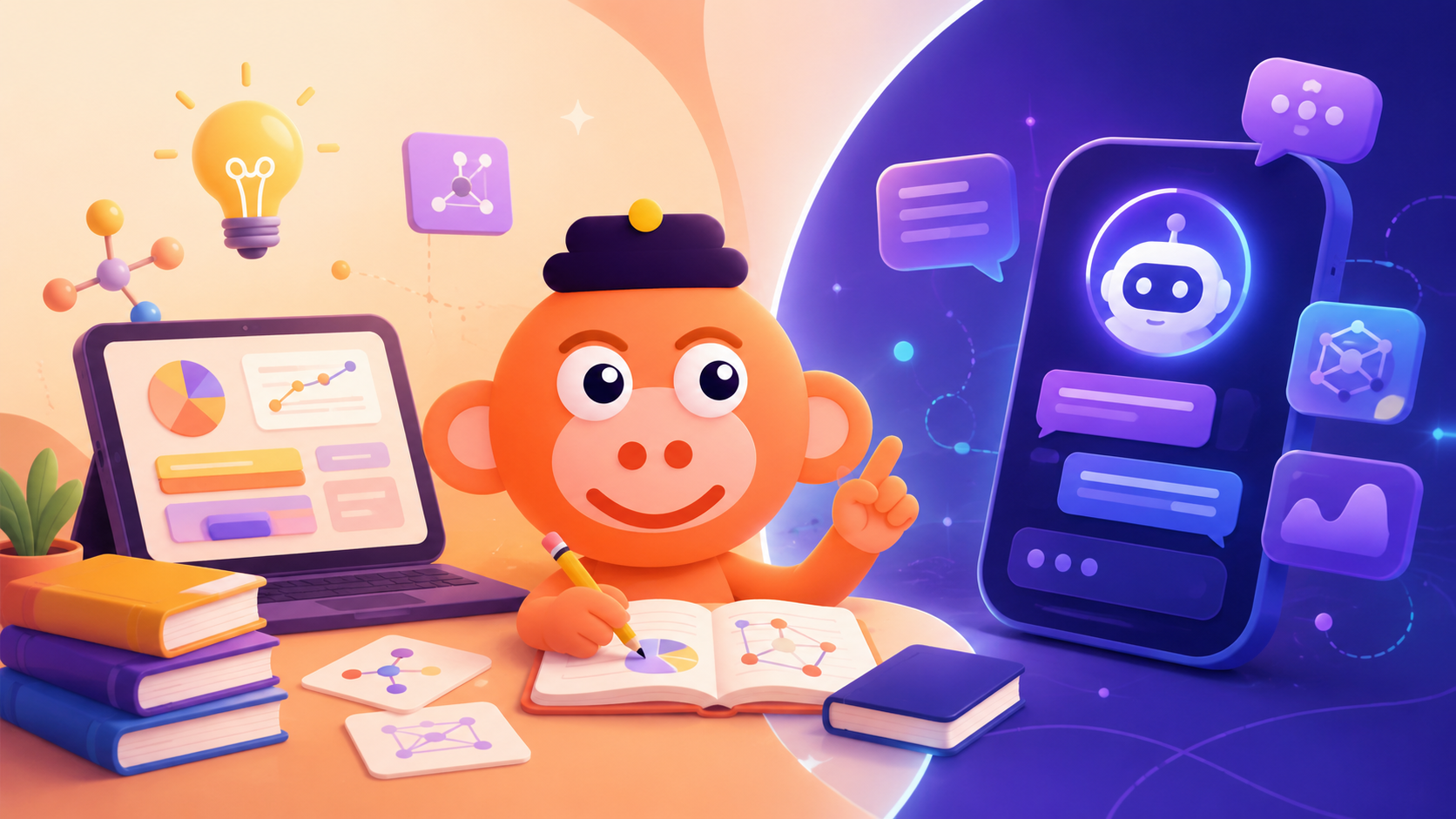
The short version is that a chat gives you answers, and learning a subject takes more than answers. It takes a direction, a memory, and a feedback loop. A general-purpose chat isn't built to provide any of those, which is exactly what an AI study buddy is for.
Where ChatGPT is great
The strengths are real, so let's start there:
- Instant explanations of almost anything, rephrased as many times as you need, with examples whenever you ask.
- No judgment. You can ask the "stupid" question you'd never raise your hand for in a classroom.
- Total flexibility. You can take the conversation anywhere, at any depth, with no rails.
For a quick unblock, a chat is the right tool. "What does this error mean," "explain this paragraph," "give me an analogy for entropy." That's a chat's home turf.
The three gaps a chat can't close
The trouble starts when you try to learn a subject instead of answering a question. Three gaps open up, and they feed on each other.
Gap 1: No path
A chat answers what you ask. But when you're new to a field, you don't know what to ask next. Should you learn matrix multiplication before determinants, or after? Is it worth understanding the Punic Wars before the Republic falls? The hard part of self-learning was never getting explanations. It's knowing the right order, and you can't prompt your way to a sequence you've never seen.
A study buddy starts by building that path for you: a curriculum with sections, summaries, and time estimates, pitched at your level. You're free to edit it, but you never sit staring at a blank prompt wondering what comes next.
Gap 2: No memory of your learning
This is the big one. Every great explanation ChatGPT gives you vanishes into the scroll. Three weeks into a subject, your "progress" is forty scattered conversations with no record of what you covered, what clicked, or what you got wrong.
A learning tool needs to hold onto things: the path you're on, the sections you finished, the concepts you missed, the feedback you got. Hold onto that and your second session can build on the first. Drop it and every session starts from zero, with the concepts you missed quietly disappearing instead of coming back for review. Spaced review is one of the most reliable findings in all of learning science, and it's simply impossible in a tool that forgets you the moment you close the tab.
Gap 3: No feedback loop
A chat is reactive. It speaks when you prompt it, and it has no opinion about whether you should move on or practice the thing again. The sneaky part is how productive it feels: you can read fluent explanations all evening and never once test yourself. Reading an explanation is a long way from being able to reproduce the reasoning, and only practice tells the two apart.
A study buddy closes that loop. It hands you exercises, checks your answers, asks you to explain your thinking out loud, and uses what you say to decide what happens next: advance, retry, or a remediation step aimed at the exact thing you missed. A wrong answer turns into data instead of a dead end.
Side by side
| ChatGPT | AI study buddy | |
|---|---|---|
| Quick answers | Excellent | Good |
| Structured path through a subject | You assemble it yourself | Generated, editable, sequenced |
| Remembers your progress | Chat history only | Path, progress, weak spots, feedback |
| Practice and answer checking | Only if you ask, ad hoc | Built into every section |
| Review of missed concepts | None | Queued automatically |
| Best for | Unblocking single questions | Learning a subject over weeks |
It's not either/or
None of this is a "ChatGPT bad" argument. They're just different tools for different moments. A chat is a brilliant reference desk. A study buddy is the course you build for yourself, closer in spirit to a structured class but adaptive in the ways static courses aren't.
Plenty of people use both: a chat for one-off questions during the day, a study buddy for the actual path through the subject. The mistake is using a reference desk and convincing yourself you have a curriculum.
A quick test
Here's a simple way to figure out which one you need. Think about the thing you're trying to learn and answer three questions:
- Could you list, right now, the next five things you should study, in order?
- Do you have a record of what you've already covered and what you got wrong?
- Has anything tested whether you actually understood last week's material?
Three yeses? Your current system works, so keep it. Two or more nos and your problem isn't a shortage of explanations. It's a shortage of structure and memory, and better prompting won't fix that.
Structure and memory are what Benji is built for: type a topic, get an editable learning path, study each section with practice and Socratic feedback, and come back tomorrow to a tool that still remembers everything. Try it free with a subject you've been meaning to learn.