Why Static Online Courses Fail Self-Learners
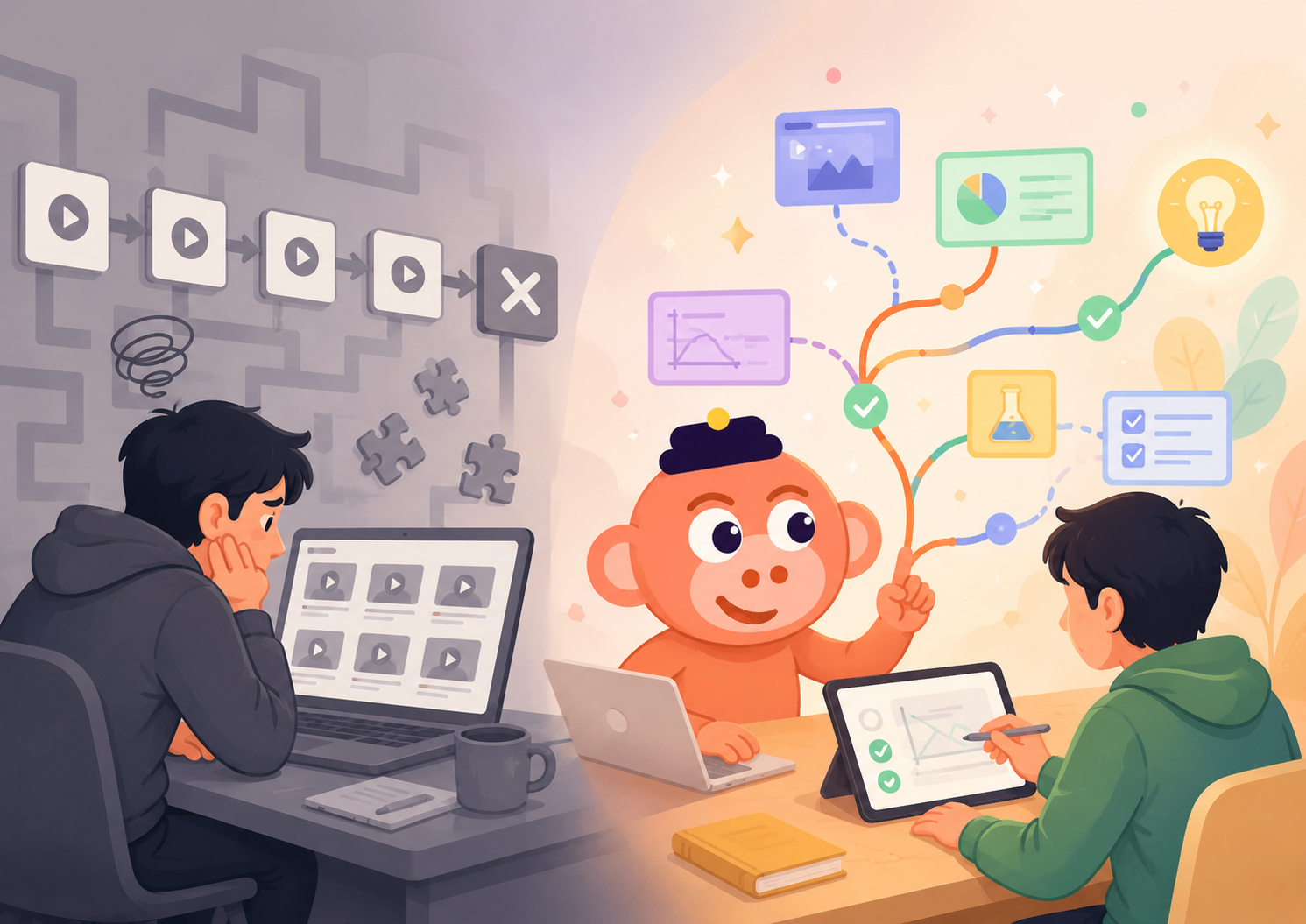
Somewhere on your hard drive, or buried in some platform's "My Courses" tab, there's probably a course you started with real enthusiasm and quietly abandoned around lesson nine. You're not lazy, and the course was probably fine. Completion rates for online courses have sat in the single digits to low teens for over a decade, across platforms, subjects, and price points. When almost everyone fails the same way, the students aren't the problem. The format is.
The core flaw: the course doesn't know you exist
A recorded course is a broadcast. Someone designed it once, for an imagined average student, and it plays back the same way for everyone. That one fact produces every failure mode you've run into.
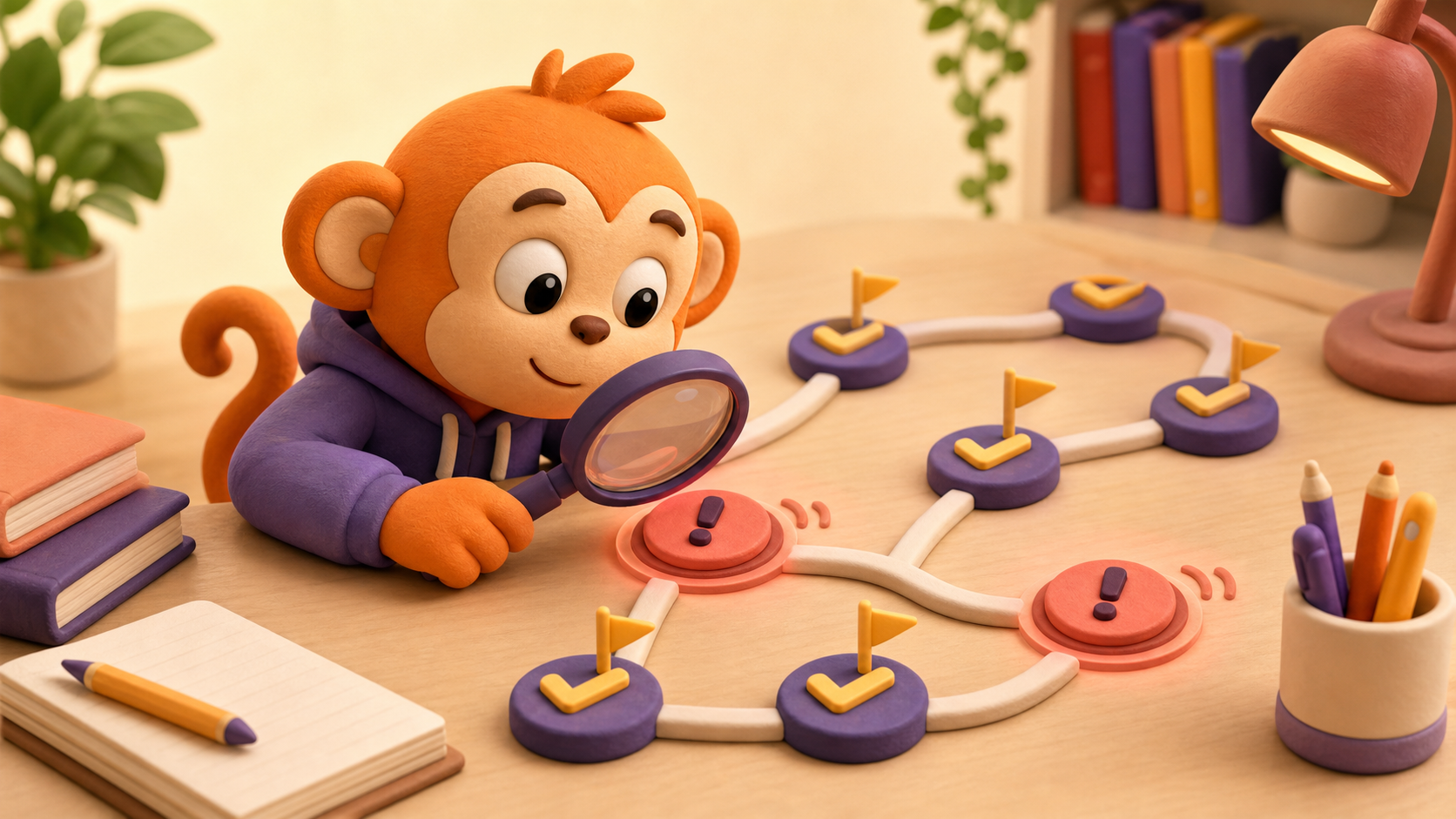
It keeps moving when you're stuck. Lesson seven assumes you fully absorbed lesson six. Half-understand a single concept, one definition or one step in a derivation, and the gap quietly compounds. By lesson ten the material feels impossible, not because it is, but because it's sitting on a floor with a hole in it. A human tutor spots the stuck point. A video can't.
It can't change pace or level. Pacing that bores an intermediate learner will drown a beginner, and the same subject genuinely needs different routes at different levels. A static course picks one audience and loses the rest.
It mistakes watching for learning. The progress bar fills because the video played, not because anything landed. Most courses test very little, review nothing, and never once ask you to explain your reasoning. So completion and mastery drift apart, and you can finish a course still unable to do the thing it taught.
Missed concepts never come back. Learning isn't a single pass. The concepts you got wrong need to resurface for review at the right moment, which is what spaced repetition does, and it's one of the sturdiest results in learning research. A linear course can't pull it off. The syllabus marches forward and your week-three confusion never gets a second look.
It can't answer your questions. When the lecture's explanation doesn't land, your options are grim: rewatch the same explanation, dig through a forum where someone asked something vaguely similar in 2019, or give up for the night. The one thing a confused learner needs is a different explanation, right now, and that's the one thing a recording will never give you.
Why this hits self-learners hardest
In a university course, the static lecture comes wrapped in scaffolding: deadlines, problem sets, office hours, classmates, a TA grading your work. The lecture can get away with being static because everything around it adapts.
A self-learner has none of that scaffolding. The recorded course is the whole system, so its rigidity is fatal. Nobody notices you're stuck, nothing forces you to practice, and there's no cost to drifting away for a week, then a month. The format quietly asks self-learners to supply their own structure, feedback, and accountability, which is the exact thing they came to a course to get.
What the alternative looks like
The fix isn't better videos. It's a format that adapts: a learning path instead of a playlist. In practice that means a few things.
- A sequence built for you. Your topic, your level, in a sensible order, with time estimates, and editable, because the first draft of any plan isn't gospel.
- Practice in every section. Not a quiz tacked onto the end of the module, but exercises where your understanding becomes visible, including open answers where you explain your reasoning instead of just clicking a letter.
- Feedback that responds to your answer. A strong answer moves you forward. A weak one triggers targeted remediation aimed at the specific gap, not a generic "review the lesson and try again."
- Memory across sessions. What you covered, what you missed, and what's due for review, all saved, so session two builds on session one instead of restarting it. That memory is the real line between a learning tool and a chat assistant, and we put the two head to head in AI study buddy vs ChatGPT.
- Checkpoints that test mastery, not completion. A good checkpoint asks "do you actually understand this yet?" and is allowed to answer "not yet" and send you back.
For a long time the only thing that offered all of this was a human tutor, which is why tutoring works and also why it costs more than most people can spend on daily support. What's changed is that AI can now run the loop itself: generate the path, evaluate the answers, target the remediation, schedule the review, all for about the price of a streaming subscription rather than an hourly rate. That category of tool is what we call an AI study buddy.
The takeaway
If you've abandoned courses before, the lesson isn't "try harder on the next one." It's that a format built as a one-way broadcast was never going to support self-directed learning, no matter how slick the production. Structure, feedback, and memory aren't nice-to-haves. They're the whole difference between watching a subject and learning it.
Benji is our shot at that adaptive format: type any topic, get an editable learning path with practice, Socratic feedback, and progress that sticks around across sessions. If there's a subject you've started and walked away from before, give it another shot with a path this time.