How to Practice Between Tutoring Sessions
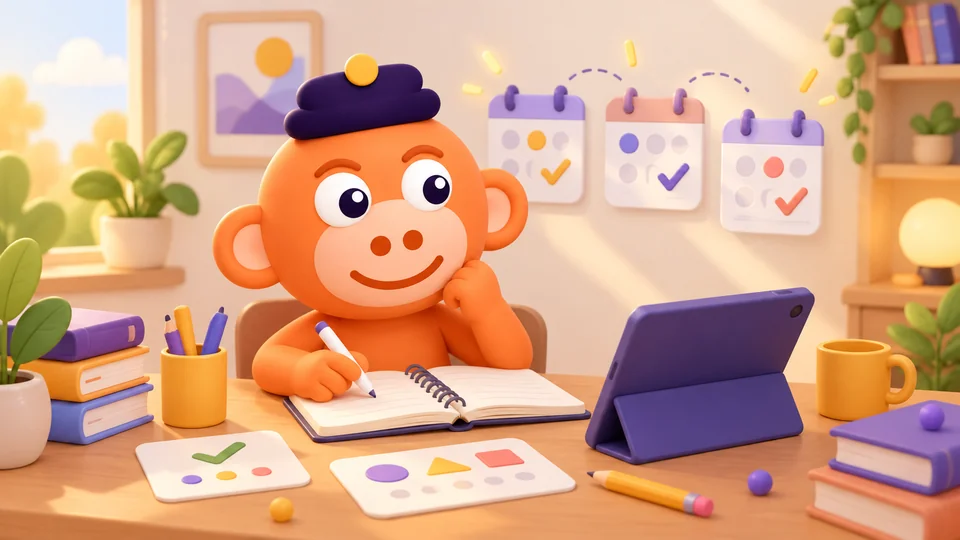
To practice between tutoring sessions, choose one skill from your last lesson, attempt a question without help, check your reasoning, and try a fresh question. Return to that skill on another day, then bring any repeated mistake to your next session. Your tutor's assigned work should guide the practice; an AI study tool can help with extra explanations and questions when you are working alone.
The aim is to arrive at the next lesson with something specific to discuss. "I studied for an hour" tells your tutor much less than "I can solve this type of question, but I get stuck when the condition changes."
Start with the task your tutor actually set
Before you close the lesson, write down what to practice, which materials to use, and what a successful attempt looks like. Ask your tutor to show one example if the assignment is unclear.
Keep the goal small. "Practice Python" is too broad to guide an afternoon. "Write a loop that adds only the positive numbers in a list" gives you a task you can attempt and check. For a history lesson, the equivalent might be explaining two causes of an event using evidence from your course reading.
If your tutor has set homework, start there. Extra questions should support that assignment rather than pull you into a different topic. A large generated study plan is less useful than a few well-chosen exercises on the skill you need this week.
Use a short practice loop
Begin by recalling the idea from memory. Close the example, explain the rule, or write the first step yourself. This shows what you can produce without a prompt.
Then attempt one question before looking at its solution. Show your working even when you are unsure. A written attempt lets you compare the actual steps, instead of deciding afterward that the solution was what you meant all along.
Check the attempt against an answer key, your course materials, or feedback your tutor has already given. Name the mistake precisely. Did you misunderstand the idea, skip a condition, make a calculation error, or misread the question?
Finally, try a new question that uses the same skill. Correcting the original answer is useful, but a fresh attempt helps reveal whether you can apply the correction. Our guide to checking whether you understand a topic gives more ways to do that without relying on how familiar the notes feel.
Alternate examples with your own attempts
When a skill is new, a worked example can make the steps clear. Read it closely enough to explain why each step is there, then put it aside and attempt a similar problem yourself.
The Institute of Education Sciences' guide to organizing study recommends alternating worked examples with problems students solve themselves. It also recommends revisiting learning over time and using questions that require learners to recall information. These are useful principles for between-lesson practice, rather than a fixed timetable everyone must follow.
If you cannot start, return to the example and identify the missing step. Ask for a small hint or a simpler question. Once you can attempt the task, reduce the help. Copying several completed solutions can leave you with neat notes and very little evidence that you can do the work independently.
A worked example: a Python loop
Suppose your tutor has shown you how to add positive numbers from a list. Here is one possible solution:
numbers = [-3, 4, 0, 7]
total = 0

for number in numbers:
    if number > 0:
        total += number

print(total)
The output is 11. The loop visits each number. The condition lets 4 and 7 contribute to the total, while -3 and 0 leave it unchanged.
Explain that before you run the code. In particular, explain why total = 0 sits before the loop. Putting it inside the loop would restart the total on every pass.
Now close the example and write your own version for [-2, 5, 8, -1]. Predict the result first: it should be 13. Run your code and compare. If you get 0, 8, or another result, examine where the total starts and when it changes.
For a fresh check, use [-4, -2, 0]. The result should be 0 because none of those numbers is positive. That case tests whether your program handles a list without any qualifying values.
The official Python tutorial on control flow explains how for loops visit sequence items and how if statements select a branch. Use it as a reference when the explanation and the code seem to disagree.
If the same mistake persists, save the code and its output for your tutor. "Why does moving this line change the result?" is a useful next-lesson question. A copied correct program would hide that question.
Return to the skill on another day
A question solved immediately after an example may still be fresh in your memory. Try another attempt later, with the example closed, to see what remains available without help.
If your lessons are weekly, you could use the following pattern. The days are a starting point to adapt with your tutor, not a research-backed rule about exact intervals.
| When | What to do |
|---|---|
| After the lesson | Confirm the assignment and explain one example in your own words. |
| On the next available study day | Attempt a few questions and record the mistakes. |
| Later in the week | Retry the difficult skill using fresh questions, with less help. |
| Before the next session | Choose an unresolved attempt and write the question you want to ask. |
This keeps spaced review connected to your actual lesson. If the material remains too difficult, shorten the task or ask your tutor which earlier skill to revisit.
Keep an error note that helps your next lesson
A useful error note includes the question, your attempt, the point where you became unsure, and what happened after feedback. You do not need a complex tracking system. A few lines beside the exercise are enough.
The Education Endowment Foundation's guidance on self-regulated learning describes planning, monitoring, and evaluating learning within a specific subject. In your own practice, that can mean choosing a task, noticing where your approach stops working, and deciding what to try next. The guidance is written for schools; this routine applies those ideas to practice between lessons.
Keep the note factual. Instead of "I'm bad at programming," write "I reset the total inside the loop and need to explain what happens on each pass." That gives your tutor something they can investigate. The guide to identifying study weak spots offers more examples of turning a mistake into a specific practice target.
Use AI support after making an attempt
An AI tool can offer a different explanation, a small hint, or extra practice. Show it your attempt and ask it to address the step you do not understand. Compare its feedback with reliable materials, since AI can make mistakes too.
Benji can organize a topic into a saved learning path with lessons, practice, answer feedback, and checkpoints. You can use that structure to continue working on a lesson topic, while keeping your tutor's assignment as the main guide. Bring persistent confusion back to the person who knows your course and can review your work with you.
If you want support for your next practice session, start a path in Benji using a specific topic from your lesson. Attempt something yourself, check it, and finish with a clear question or a skill you can now use without help.